




If you don’t have much experience with touring in Europe—or touring at all—and you are on a tight budget (which often goes hand in hand), these tips will help you bring the most useful items along. In the chaos of tour prep, it’s easy to forget the little things, so here is your ultimate checklist.
1. Chargers, adapters and power banks
You will need travel adapters for your personal electronics like phones and laptops, as well as the right power adapters for your equipment. In addition to your regular charger, always bring a car charger for the long drives. To minimize the number of adapters you have to carry, simply bring a power strip from home.
Also, if you use standard 9-volt block batteries in your guitar pedals, you won’t need to worry about extra power supplies for them on stage.
Finally, a high-capacity power bank is absolutely vital on tour—your phone is your lifeline, and local promoters or bookers must always be able to reach you if schedules or meeting points change.
Here you can find an overview about electric systems used around the world.
2. Guitar strings, drum sticks and guitar picks of your favorite brand
It is a massive waste of precious tour time if you have to hunt down a music store on the road just for basic consumables.
 In Europe, you generally won’t find a music shop on every street corner, and in smaller towns, there might be none at all. (For example, you might find plenty of shops in Ireland, but significantly fewer specialized stores in Austria or Italy).
Furthermore, many smaller local stores might exclusively specialize in pianos or brass instruments, meaning they won’t carry your specific favorite brand or string gauge, and they can be way more expensive than back home. Stock up on everything before the tour starts, and carrying extra replacement heads for your snare and bass drum is never a bad idea either.
3. Smartphone: navigation, eSIM & car mount
Your smartphone is the ultimate tour control center, but it’s only useful if it actually has a working connection.
Crucial for international tours: Download a digital eSIM app (like Airalo or Holafly) before you land. This gives you instant, cheap local data the second your plane touches down.

You should always prepare for worst-case scenarios. If you decide to use your smartphone for navigation, it makes total sense to save your tour routing area in Google Maps for offline access before you hit the road. This ensures you can still navigate even when you lose network coverage in rural areas or mountains.
Don’t forget the mount: When you’re switching drivers during a long overnight haul, the last thing you want to mess with is a clunky plastic phone cradle that requires two hands to adjust. This is actually exactly what I use myself whenever I’m on the road, and I love it: a compact, magnetic phone mount that clips right into the van’s air vents*.
Combined with a magnetic phone case (or a small metal plate stuck to the back of your device), it is an absolute game-changer. You can literally slap your phone onto the mount with one hand in a split second and take it off just as fast.
4. Gaffer (duct) tape and zip ties
You can fix almost anything on the road with a roll of high-quality gaffer tape and a pack of heavy-duty zip ties. They are not just lifesavers for emergency van or gear repairs, but also crucial for taping down your cables on stage etc.
5. Tour itinerary
You obviously need to carry all relevant details for your upcoming shows, including the phone numbers of all promoters, venue addresses, load-in times, dinner schedules, and stage times. Always keep a printed physical version of this itinerary in the tour van. You cannot rely solely on your phone, as batteries die, screens smash, and digital files can become inaccessible right when you need them most.
6. Money Belt
If you still get paid for your shows and merchandise in cash, a money belt fastened around your hips is highly recommended to store your funds safely until you can deposit them.
However, Europe is moving rapidly toward a cashless society:
7. Mobile Card Reader
In some European countries like the UK, the Netherlands, or Scandinavia, cards and mobile payments are preferred everywhere. To avoid losing more than half of your potential merchandise sales, your band should carry a small, mobile card reader* that connects to your phone via Bluetooth.
Keeping cash across Europe: Which countries use the most?
8. Tablet with headphones
If you don’t want to carry your laptop around, bring a basic tablet and a good pair of headphones instead. It’s perfect for dealing with day-to-day tour business, promoting your shows on social media, or simply watching movies and playing games to pass the time during long drives and endless backstage waiting hours.
I personally use and love the super comfortable Bose QuietComfort Active Noise-Cancelling headphones*, which have already saved me in quite a few festival backstage tents with nearby techno stages blasting away. For everyday use as a headset etc., I use the equally comfortable soundcore V20i open-ear headphones by Anker*, because I find in-ear headphones quite uncomfortable in the long run.
9. Camera
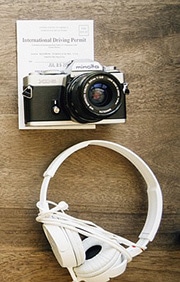
Whether you bring a dedicated camera or rely entirely on a high-end smartphone, make sure it can capture crisp, high-resolution images—especially in low-light environments like dark clubs. A great camera is vital for so much more than just quick snapshots; you can use professional-grade photos for future album covers, gig posters, merchandise designs, and official promo materials, not to mention capturing lifelong memories.
On top of that, social media is non-negotiable on tour: if you aren’t posting visual content while on the road, the rest of the world simply assumes your band isn’t touring at all. To keep your fans entertained, engaged and informed about your journey, aim to post at least two or three of your best pictures or videos on your official profiles each week.
10. Ear plugs
Even if you refuse to wear earplugs during your own set, protecting your hearing is absolutely crucial if you want a long career as a musician. You should always have a pair handy to protect your ears from the constant exposure to high-volume environments that you will inevitably encounter on tour.
On top of that, you might need them later to get a good night’s sleep. They are your only shield against snoring bandmates, annoying smartphone beeps etc.
Protect your hearing and get some sleep—find high-quality musician earplugs at Gear4music*.
11. Sleeping bags and travel pillows
In most European countries, venues and promoters usually provide sleeping accommodations for bands. This can range from simple mattresses at private places or venues to hostels, hotels, band rooms, or entire band flats. However, you should always have some sleeping bags with you, even if you mainly plan to stay in hotels. You might have to wait in the van for hours or crash unexpectedly, and even during summer tours, it can get cold at night, especially in mountainous regions.
If you fly want to save space in your luggage, you can easily buy cheap sleeping bags on the road at outdoor stores, hardware stores, or large supermarkets. You can also ask your tour van rental company, booking agent, or local friends if they can organize some for you before you arrive. It’s also nice to bring your own pillow to use for quick naps in the van.
12. Microfiber Travel Towel
At some sleeping places, you won’t find fresh bath towels for every single band member, so it is always better to bring your own. A dedicated microfiber travel towel saves you loads of space in your bag, dries incredibly quickly, and absorbs much more water than a standard household towel.
A towel is about the most massively useful thing an interstellar hitchhiker can have. Partly it has great practical value. You can wrap it around you for warmth as you bound across the cold moons of Jaglan Beta; you can lie on it on the brilliant marble-sanded beaches of Santraginus V, inhaling the heady sea vapors; you can sleep under it beneath the stars which shine so redly on the desert world of Kakrafoon; use it to sail a miniraft down the slow heavy River Moth; wet it for use in hand-to-hand-combat; wrap it round your head to ward off noxious fumes or avoid the gaze of the Ravenous Bugblatter Beast of Traal (such a mind-boggingly stupid animal, it assumes that if you can’t see it, it can’t see you); you can wave your towel in emergencies as a distress signal, and of course dry yourself off with it if it still seems to be clean enough.”
― Douglas Adams, The Hitchhiker’s Guide to the Galaxy
13. Sleeping mask
A comfortable sleeping mask can be another lifesaver on the road. It is essential for blocking out the sun during long daytime drives in the van, or when you have to crash in backstage rooms and band flats that don’t have any curtains or blinds to block out the light.

14. Hoody
For most touring musicians, a hoody is the number one clothing item anyway. The hood keeps you warm and serves as a perfect makeshift blindfold to block out the world around you when you’re trying to catch some sleep.
15. Sun glasses
Sunglasses are strictly necessary for long driving shifts against the sun – and for enduring hangovers.
16. Painkillers
Also necessary for those hangovers. Depending on where you live and where you tour, it pays to pack these in advance. For example, if you come from the US or the UK and are touring in Germany, bring your own painkillers from home, as they are significantly more expensive and only sold in small packs at pharmacies in Germany.
17. Dry Shampoo
This is a fantastic invention. More often than not, the entire band has to share a single bathroom, and the schedule is brutally tight. If you don’t have time for a proper shower, dry shampoo ensures your hair doesn’t look greasy on tour.
18. Flip flops
If you’re unluccky, your bathroom will be shared with the local crew, other bands or even gig-goers. You will be incredibly happy to have a pair of flip-flops when you need to use the toilet or shower at night. Besides, it’s always a relief to give your feet a well-deserved break from heavy stage boots or sweaty sneakers.
*In this blog I offer you my expertise and experience free of charge. The blog even costs me time and money. Therefore I turned some of the links to the useful things I recommend here into partner links. I only recommend what I know and use myself. If you buy something through one of these links, I get a small commission. If you decide to do so, it won’t cost you anything while it helps me to keep this site alive.
Author: Mary
